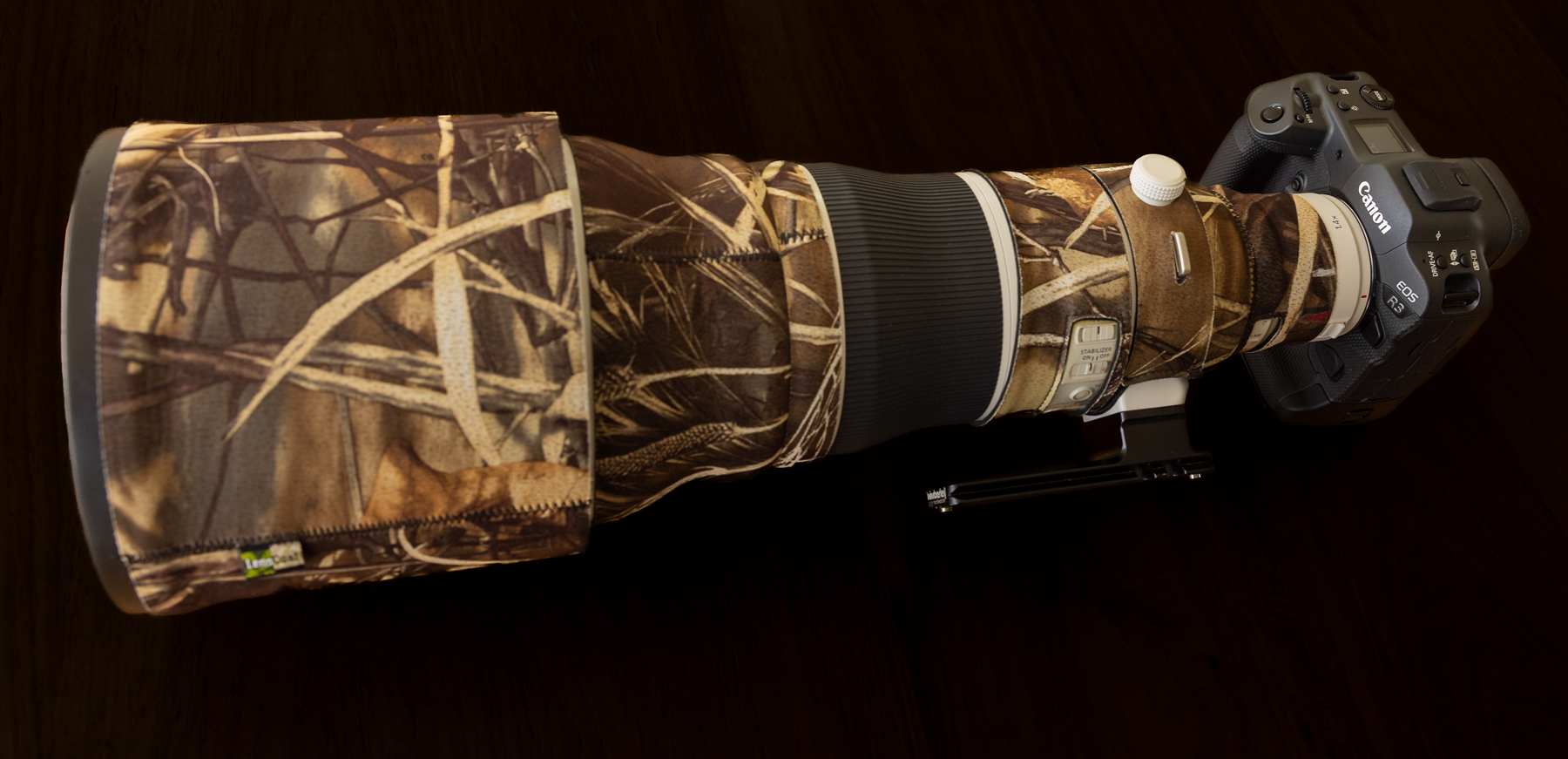
Impressions and review of photographic equipment used in the Kgalagadi Transfrontier Park.
Following our recent trip to the Kgalagadi, I thought it would be worth setting out my impressions of the photographic equipment used – particularly the camera bodies and lenses.
Firstly, just a few thoughts on photographing in the Kgalagadi. On this recent trip I focused on raptor photography and particularly on raptors in flight. See the four blogs that I wrote containing different raptor situations. Light is a challenge in Kgalagadi as you are restricted to the roads, so it is often difficult to obtain the best light angles on the subjects. Often, especially in the early morning light, you are shooting into or across the direction of light, whereas as I ideally like the light to be directly behind me for most shots. The optimal light quality is at sunrise and just a few hours after that. The roads generally run from north to south, so you have good light for a while on one side of the road but not the other.
Subject matter, in this case raptors either perching or in flight, can be relatively close or quite distant. This means long lenses – mostly with 1.4x extenders attached. You also want fast shutter speeds which means shooting at higher ISO’s. With the newer camera bodies and excellent software options the higher ISO’s are not a problem. In fact, I shot a few night images of animals at a waterhole at ISO 25600 and obtained very usable images.
98% of the images that I shot were captured using three lenses: Canon EF 600mm f/4L IS II USM, Canon RF 400mm f/2.8L IS USM and Canon RF 70-200mm f/2.8L IS USM Z lens. Three camera bodies used were: Canon EOS R3, Canon EOS R5 Mark II with battery grip and Canon EOS R5.
Total images captured using the above bodies and lenses amounted to 9470, broken down as follows:
Canon EOS R3 –
With Canon EF 600mm f/4 (bare) 226
With Canon EF 600mm f/4 and 1.4x extender III 974
With Canon RF 400mm f/2.8 (bare) 84
With Canon RF 400mm f/2.8 and 1.4x extender 1059
With Canon RF 70-200mm f/2.8 Z 329
Total 2672
Canon EOS R5 Mark II –
With Canon EF 600mm f/4 (bare) 0
With Canon EF 600mm f/4 and 1.4x extender III 775
With Canon RF 400mm f/2.8 (bare) 0
With Canon RF 400mm f/2.8 and 1.4x extender 4616
With Canon RF 70-200mm f/2.8 Z 0
Total 5390
Canon EOS R5 –
With Canon RF 70-200mm f/2.8 Z 1408
Overall Total 9470
Some quick observations/conclusions from the above table
Not many images were captured with the EF 600mm f/4 and the RF 400mm f/2.8 without 1.4x extenders attached. This is really just a factor of distance to subjects, particularly with birds in flight. You may well think that a 500mm lens would be a better bet than a 400mm lens with a 1.4x extender – in spite of a slight focal length advantage for the 400mm with 1.4x extender (560mm v 500mm). The major advantage of shooting with the 400mm, even with a 1.4 extender, is the maximum aperture. You could say an RF 100 -500mm lenswould be better. For versatility yes, but speed no – f/4 v f/7.1. The resultant shutter speeds (at same ISO) would be say 1/3200 sec with the 400 + 1.4x v 1/1000 sec at 400mm with the zoom and the latter without the advantage of the extra focal length. In any case, Canon have not made an RF 500mm f/4l lens to replace the EF version.
By far the majority of images were captured using the RF 400 f/2.8L and RF 1.4x extender with both the R3 and the R5 Mark II bodies. This was my go-to lens combo for birds in flight. This is much lighter to hand hold than the EF 600mm f/4L with RF/EF adapter and the EF 1.4x III extender.
Most smaller birds required the 600mm f/4 with extender. I did use the 600mm f/4 a lot more with the R5 Mark II body – because of the ability to crop with the latter’s 45MP v 24MP sensor of the R3.
Impressions of the lenses and bodies
Much preferred the R3 body to the R5 Mark II body (with battery grip). The ergonomics of the R3 is superb – just feels right in your hands with all the buttons in the right places. The R3 is very much more comfortable in the vertical orientation. The R3 also gets the nod for battery life, although with the battery grip the R5 Mark II is not too bad. Having just one battery is also an advantage when charging because you need two R5 battery chargers if you want to charge the two batteries that go into the battery grip. I carry more R5 spare batteries than for the R3.
In my opinion the R3 autofocusing was slightly better than the R5Mark II. I found the R5 m2 losing focus after being on the subject for a while and also if there was any obstruction, like grass, in the way. I seemed to miss a number of birds in flight shots with the R5m2. It would lose focus and you would need to refocus again. I have set up both bodies with the AF-ON button using spot AF selection point without tracking and the * button using Whole area AF and tracking on. When this “focus jumping” occurs I push the AF-ON button to refocus and the go back to the * button to keep tracking. Also helps to manually pre-focus the lens to roughly where the bird or subject is. This problem did happen a few times with the R3, but not as much as on the R5m2. It could also be a factor of the lens, as I found the RF 400’s AF better than the EF 600’s AF. Pre-focusing is an advantage on the R5m2 – the R3 does not have pre-focusing. Am looking forward to the firmware upgrade for the 5m2, which should fix some of the AF issues that seem to have crept in with the 1.0.3 version update.
Regarding lenses: Both the RF 400 and the EF 600 produce excellent quality but I do believe the 400 is slightly better. On its own (without an extender), the 400mm lens is superb.
However, the lens that really surprised me was the RF 70-200mm f/2.8L IS USM Z lens. I had this pretty much permanently attached to an R5 body (without battery grip). The images produced with this lens just seem to pop out at you with very good contrast and bokeh. This lens is not often used for birds or even less for birds in flight. However, when I did get close enough to a Martial Eagle, this combo produced some outstanding images. See Blog on the Kgalagadi (Part Four). I still think the R5 is an outstanding camera body. I did also use it with an RF 15-35mm f/2.8L IS USM lens and an RF 28-70mm f/2L IS USM lens.
In summary, I prefer the R3 to the R5 Mark II but the latter has the advantage of the 45MP sensor which gives you more options for cropping in post. The R3’s low light performance is much better than the R5 Mark II. All lenses were excellent but the 400mm f/2.8 is the best in my opinion. I think the 70-200 is going to be just as good for mammals and subjects that are closer to the camera.
Other gear
From the car, I used my BLUBB® bean bag on the window sill and hand held the rigs for birds in flight and some other shots. The image stabilisation is excellent for all three bodies. My tripod is a Gitzo® 1548 Tele Studex Mark 2 Carbon fibre model. Used that on the verandah of the river chalet at Mata-Mata and captured some good night images (slower shutter speeds) at the waterhole. This has been an excellent tripod – very stable and can carry a high capacity load. I use a Really Right Stuff® PG-02 LR Pano-Gimbal Head or an RRS BH-40 ball head. Both very well engineered and finished off.