
Part four of the blog on our recent visit to the Kgalagadi covers our stay at Mata Mata where we spent 5 nights (four full days). After our fairly long drives around Twee Rivieren and then the long drive to Mata Mata, we decided to have the next day off and we spent an enjoyable day on the verandah of our River Front Chalet and walking around the camp. During the next three days we travelled to the Kamqua picnic site or to the 14th or 13th Waterholes. There was good viewing each day with numerous Gemsbok, Springbok, Giraffe and Red Hartebeest and, of course, the smaller mammals like Ground Squirrels, Mongooses and Suricates (Meerkats). The only cats we saw was a Cheetah walking in the long grass near Kumqua and a pride of Lions feeding on a Giraffe kill. The latter was far off the road and not at all suitable for photography – mainly because of the awkward light angle.
Raptors were still reasonably plentiful but not nearly as many as we saw in the Twee Rivieren/ Melkvlei area. As I mentioned in the “Part Three” blog, there was a rather sedate Martial Eagle perched in a tree close to the road of the 14th Borehole loop. On the trip each day, I faithfully sat at this spot hoping that the eagle would fly. We had not seen any other Martial Eagles during our trip, so I was anxious to get some good action images of this one. Alas, this did not happen on the first two day trips we did. Each day the Martial Eagle just perched on a branch and it was in a difficult position to photograph with twigs and branches in the way, no matter how we tried to position the vehicle.
Luckily on our last day, as we were driving back to Mata Mata, the eagle had moved its position slightly and the sun angle and brightness was more favourable than we had encountered previously.
To frame the bird and exclude almost all of the branches and twigs, I used the RF 400mm f/2.8 lens with an RF 1.4x extender – effective focal length 560mm. There was a fairly stiff breeze blowing which the eagle was facing into – a good starting point for a take off. Amazing what a small change in position can make to an image. My wife had also moved the car just a few feet to get the best possible angle.
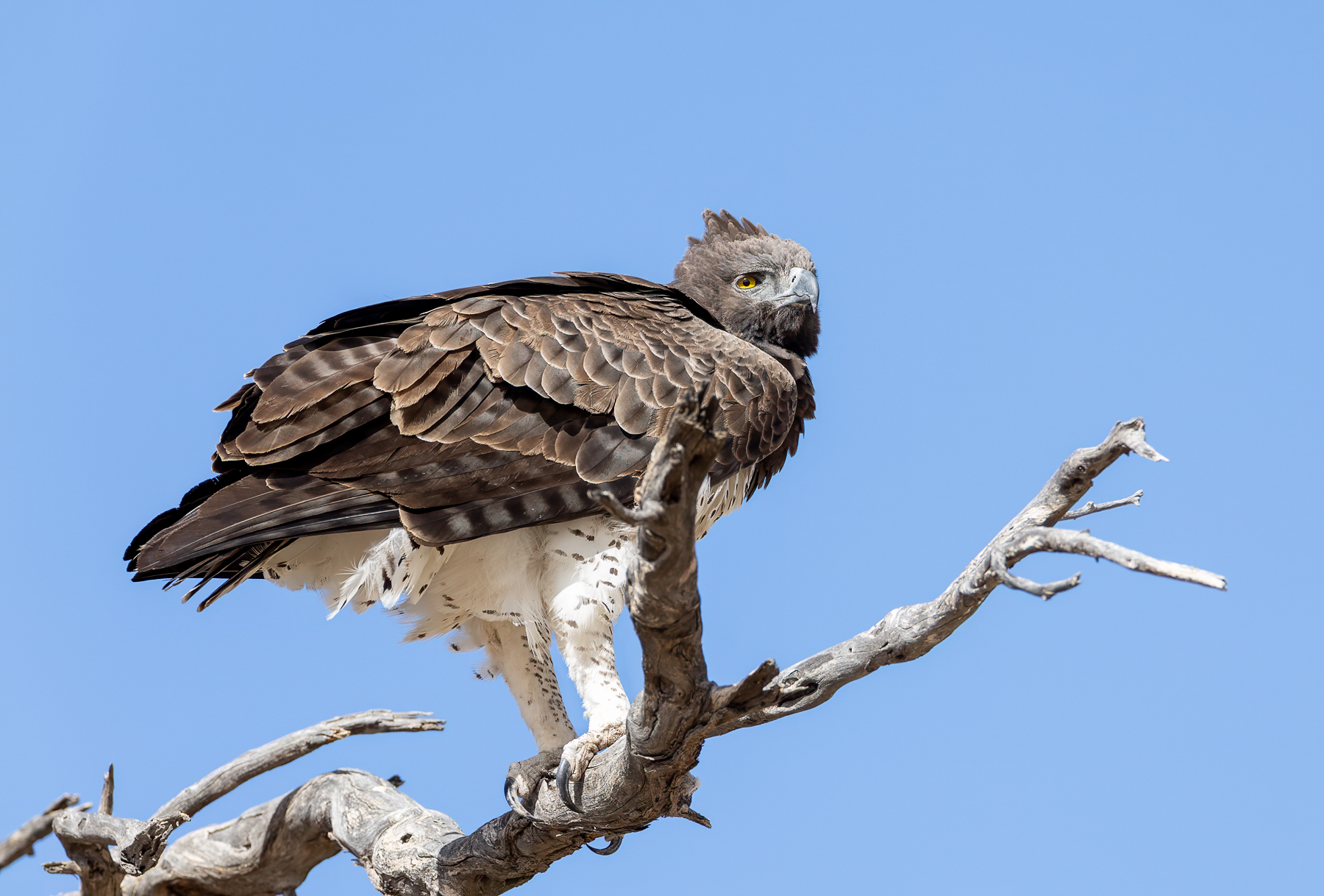
Martial Eagle (Polemaetus bellicosus). Kgalagadi Transfrontier Park, Northern Cape Province, South Africa.
Canon EOS R3 with Canon RF 400mm f/2.8L IS USM lens and Canon RF extender 1.4x. Beanbag mounted.
ISO 800. 1/2000sec. @ f/5.6. Exposure set manually.
The bird then turned the other way around with its head turned towards me. I wanted to capture a few head shots so changed to the R5 Mark II body with the 600mm lens and 1.4x extender – effective focal length 840mm.
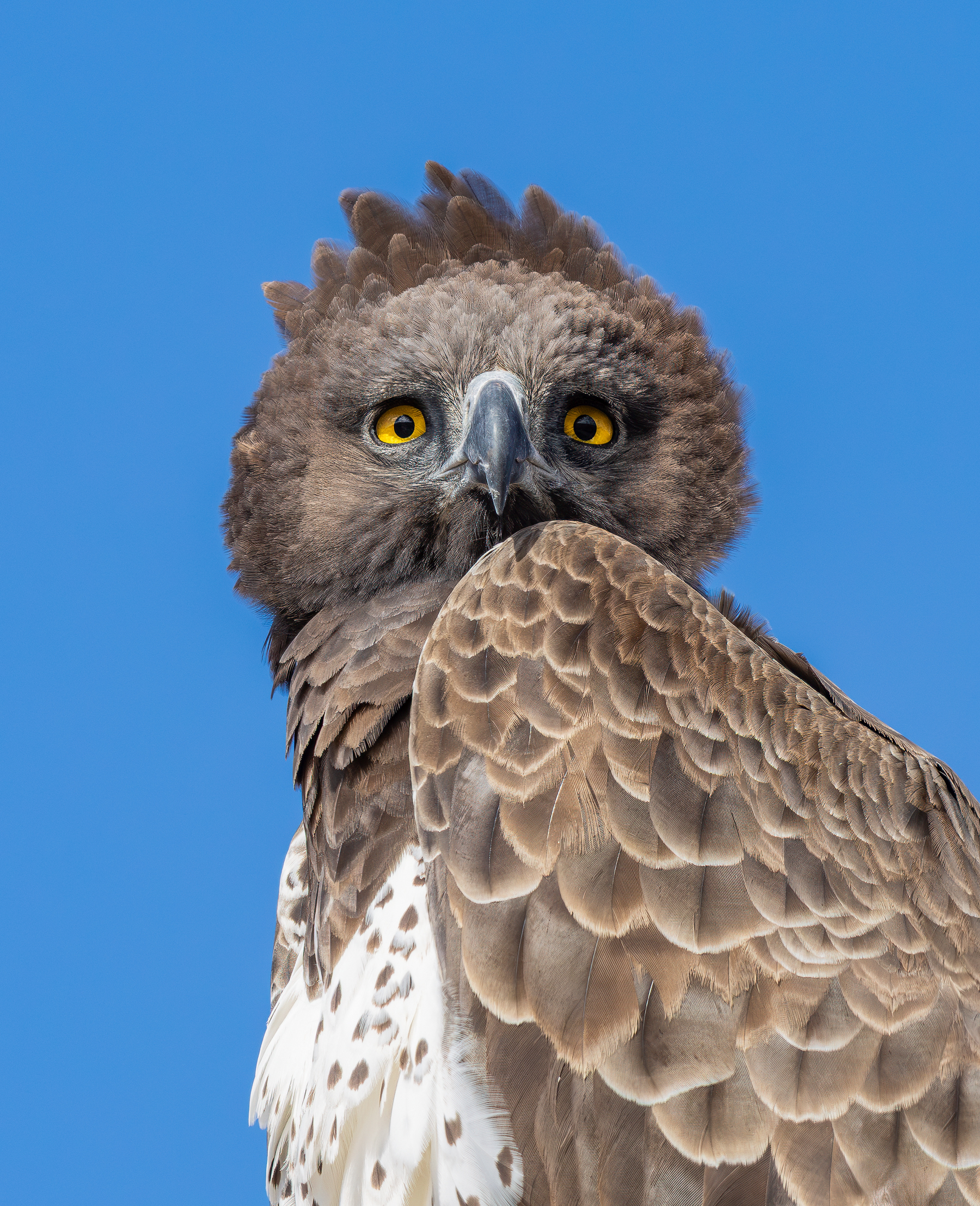
Canon EOS R5 Mark II with Canon EF 600mm f/4L IS II USM lens and EF 1.4x extender. Beanbag mounted.
ISO 800. 1/1600 sec @ f/8. Exposure set manually.
The eagle then turned around again, facing into the wind and this time looked more like it wanted to fly.
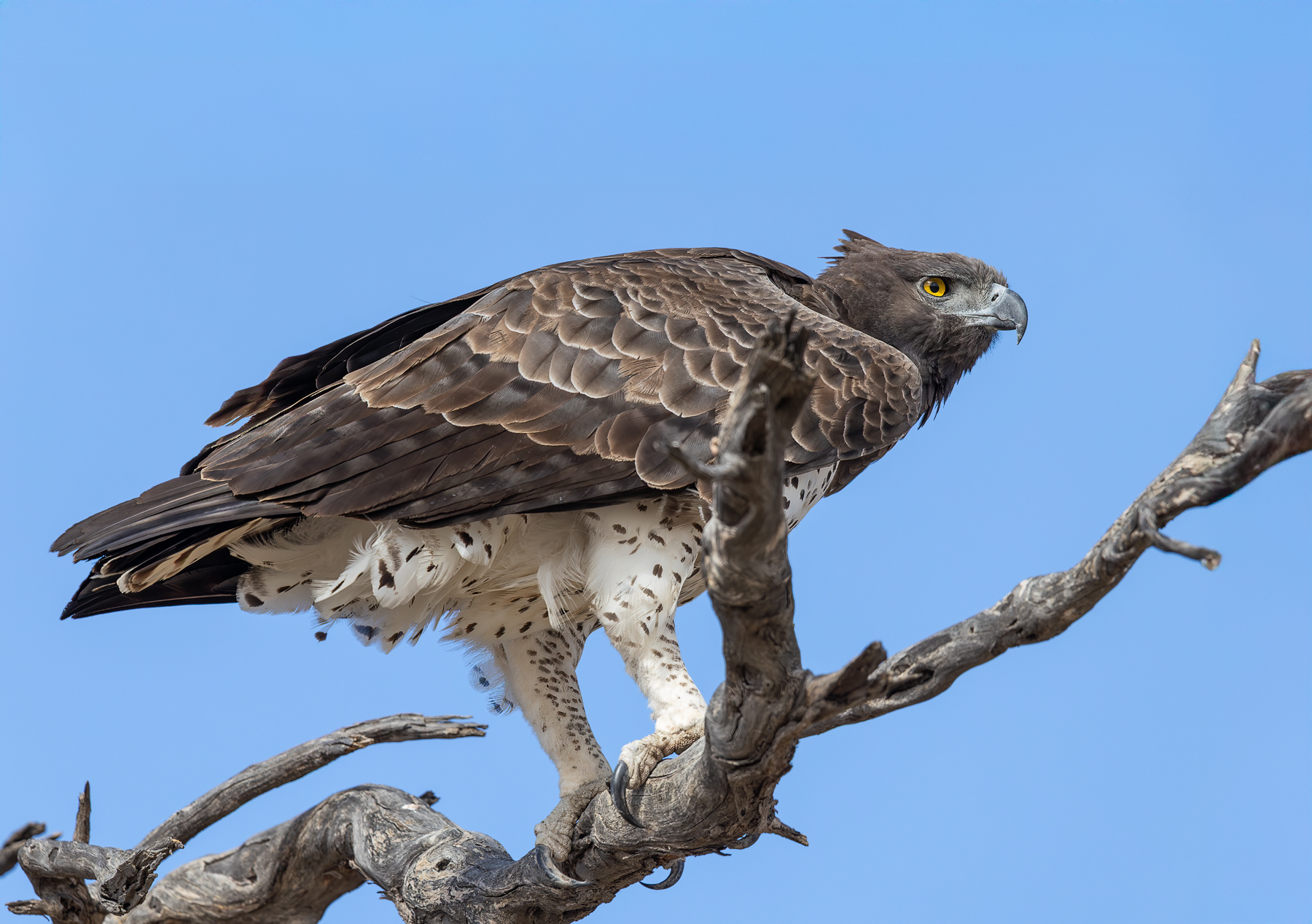
Same camera settings as previous image.
At this stage I reckoned that, if it took off, I would need a much shorter focal length lens as its wings would certainly be cut off using the 600mm lens and possibly even the 400mm lens and I also wanted to show the type of background. I opted for my RF 70-200mm f/2.8L IS USM Z lens which was attached to a Canon R5 body.
The following image gives you the perspective of how the bird was perched. Part of the nest can be seen in the bottom right of the image.
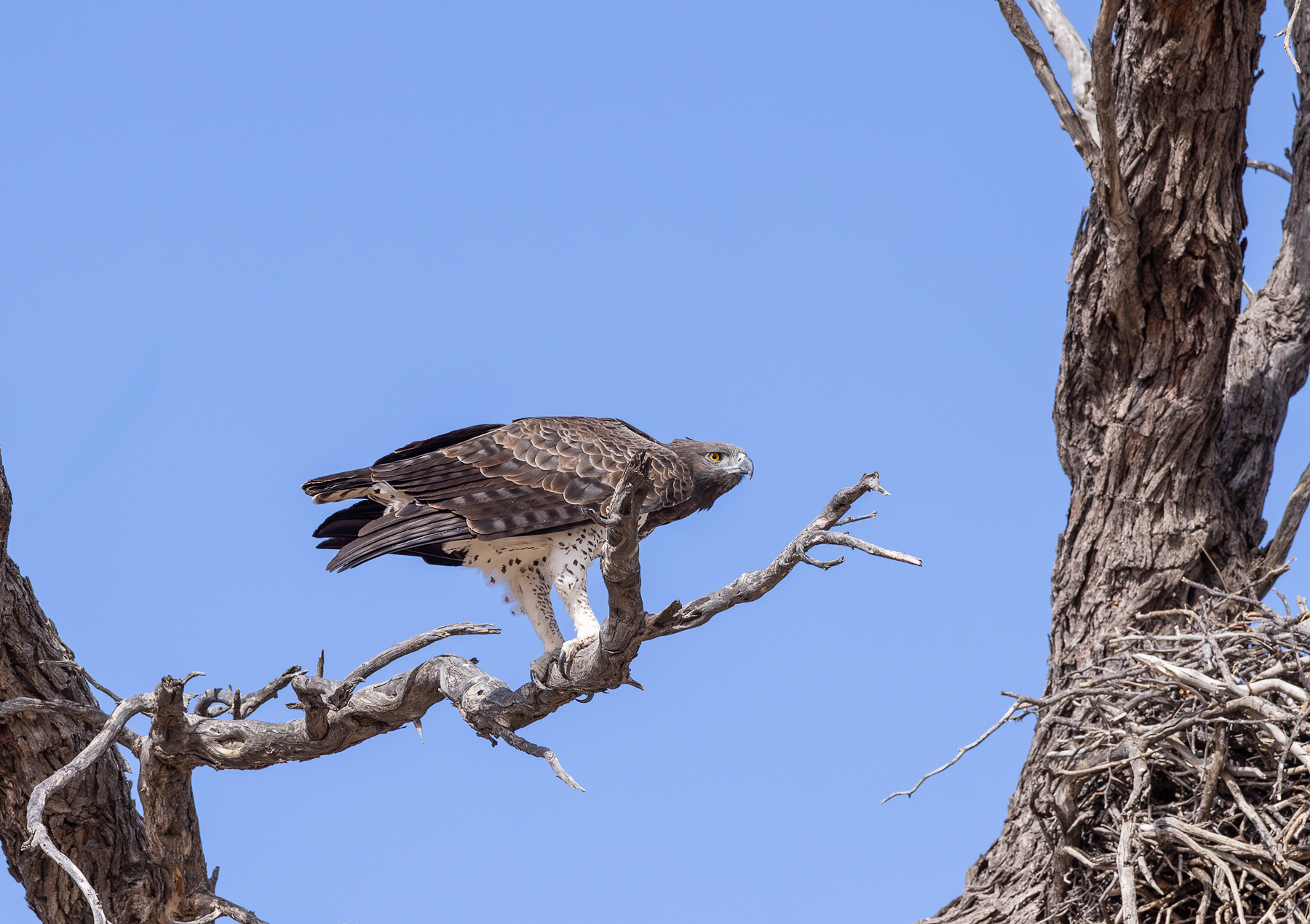
Canon EOS R5 with Canon RF 70-200mm f/2.8L IS USM Z lens @ 200mm. Now handheld.
ISO 800. 1/2500 sec @ f/6.3. Exposure set manually.
And then it did take off. The following six images were extracted from a burst of just less than 1 second. The images also illustrate the background and position of the bird in the tree and why it was so difficult to photograph. All images had the same settings:
Canon EOS R5 with a Canon RF 70-200mm f/2.8L IS USM Z lens @200mm. Handheld.
ISO 800. 1/2000 sec @ f/6.3. Exposure set manually
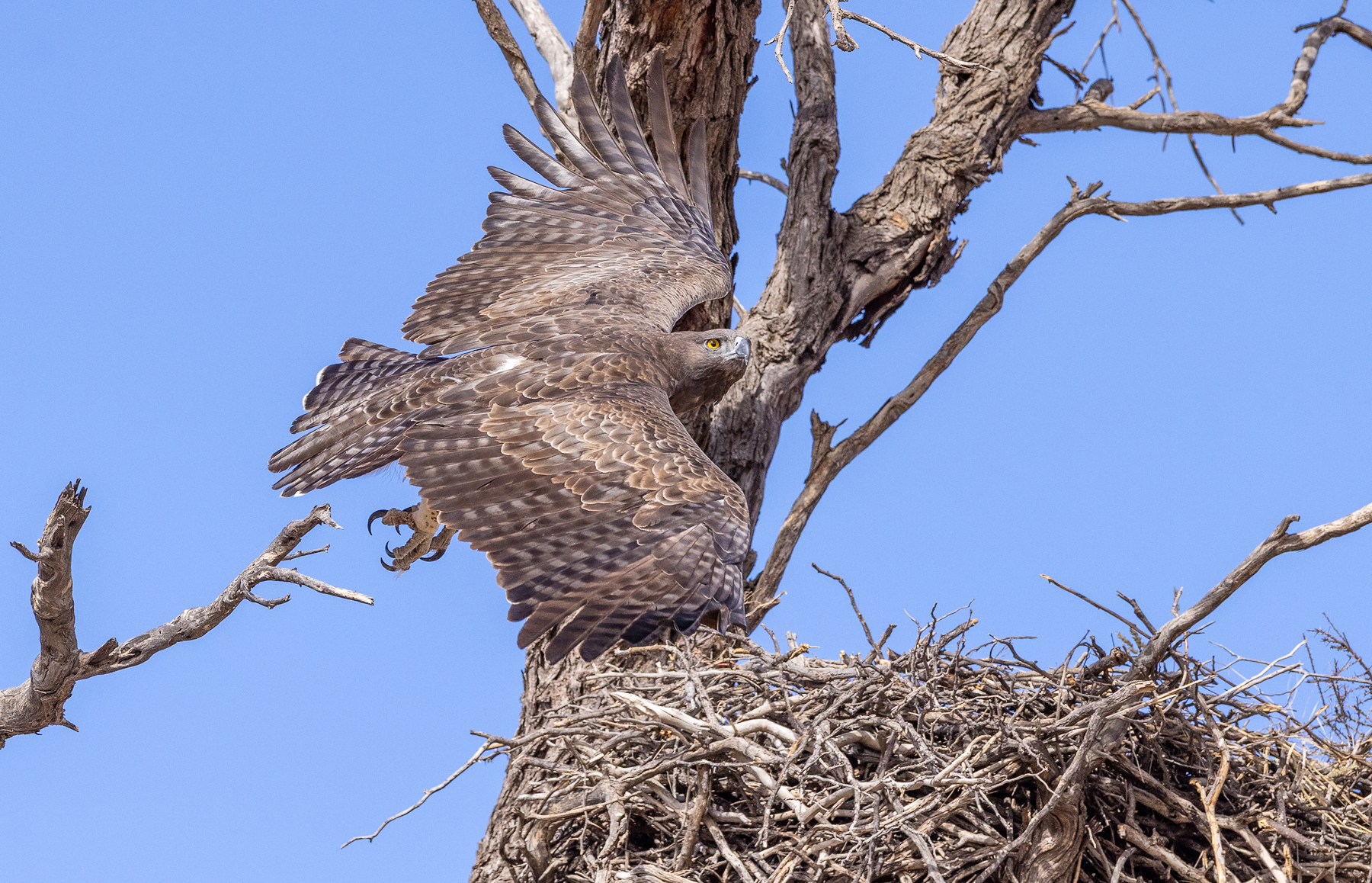
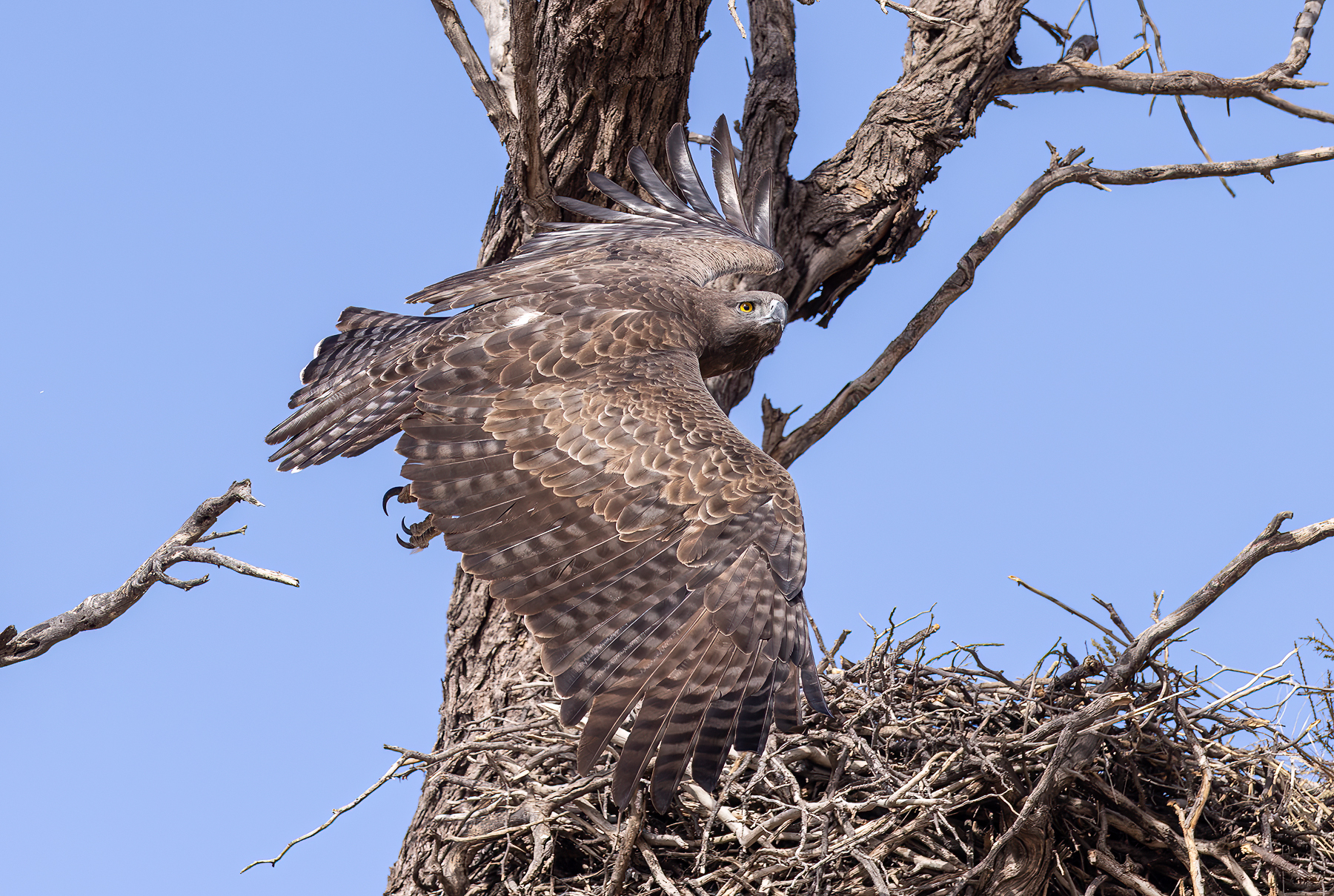
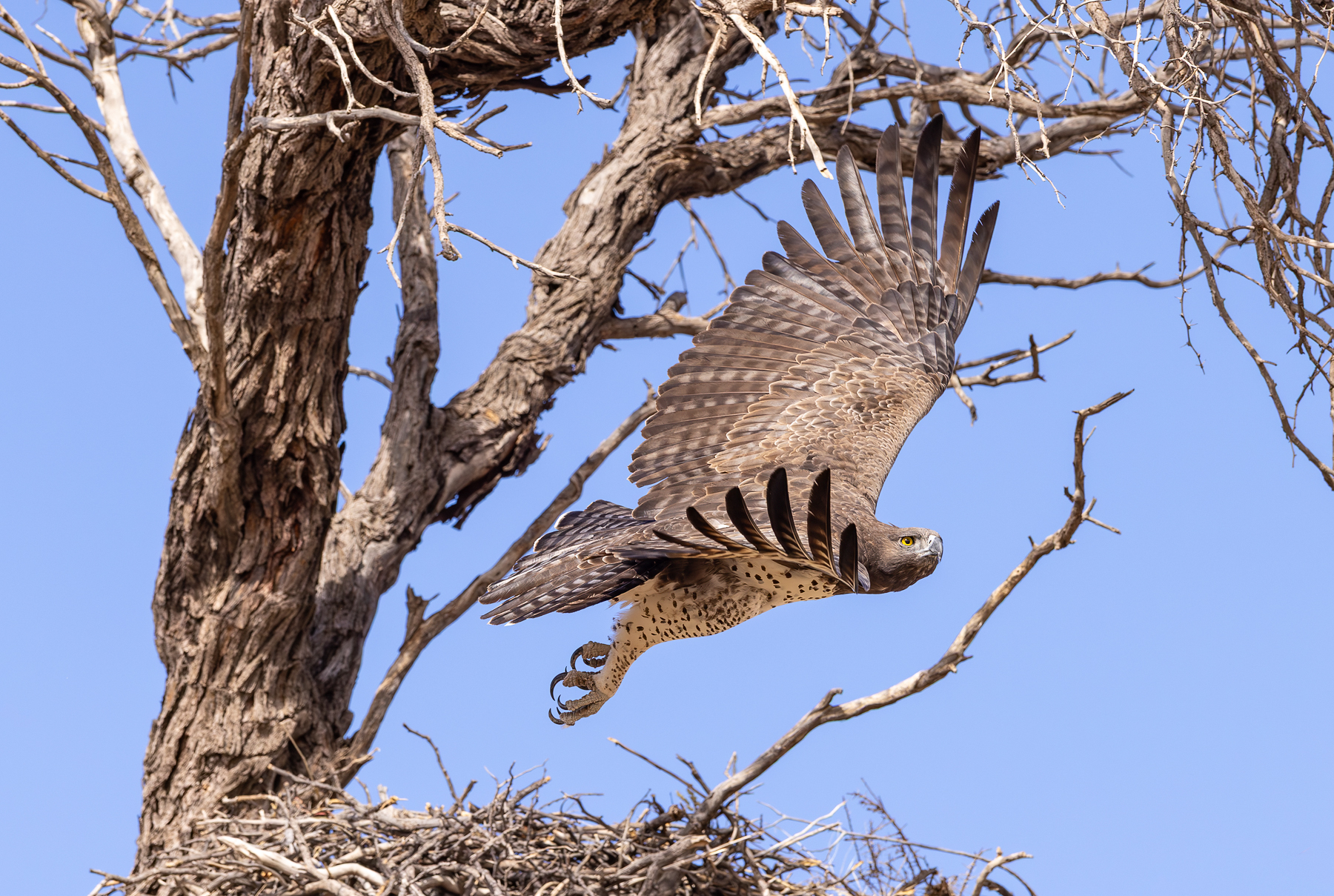
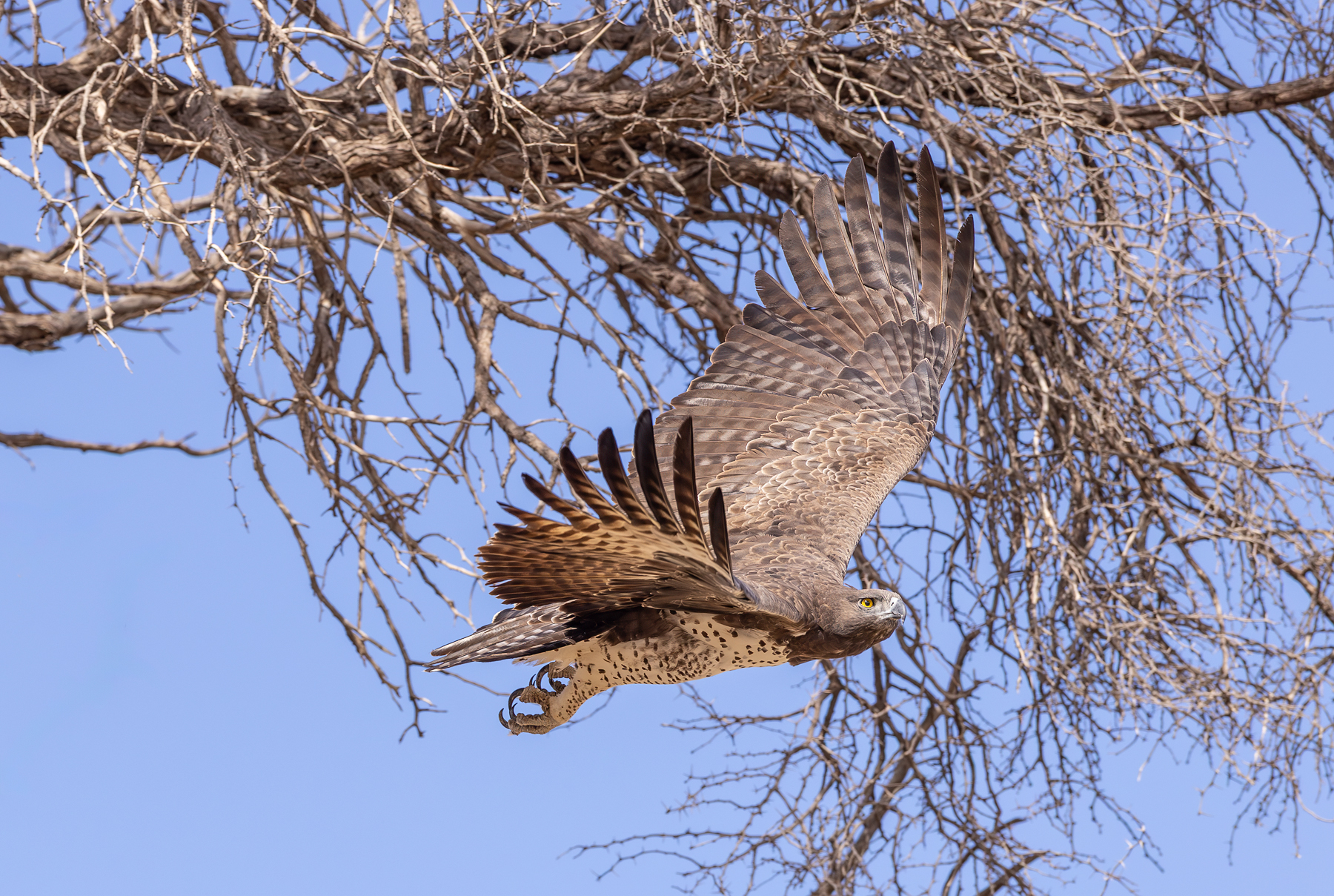
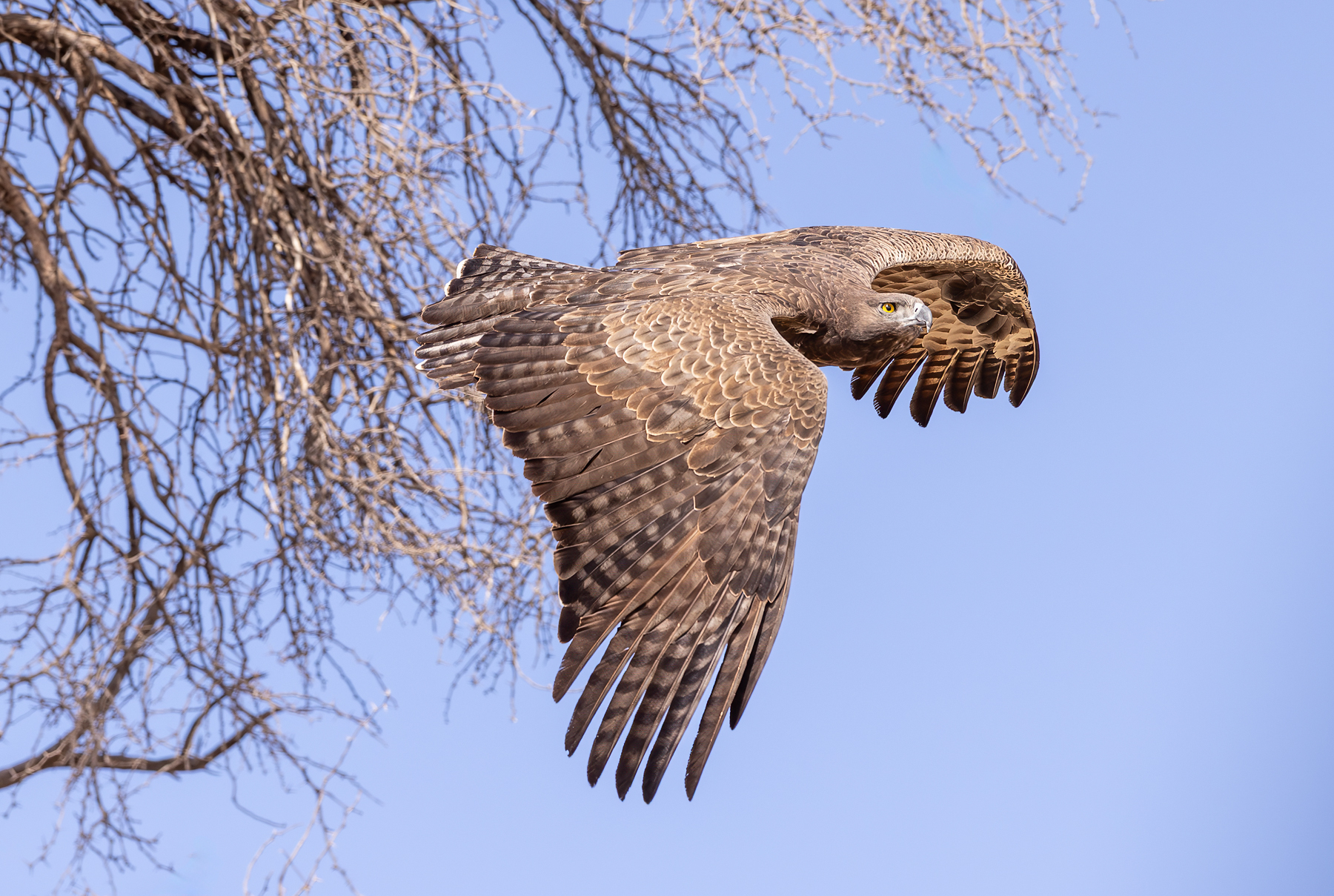
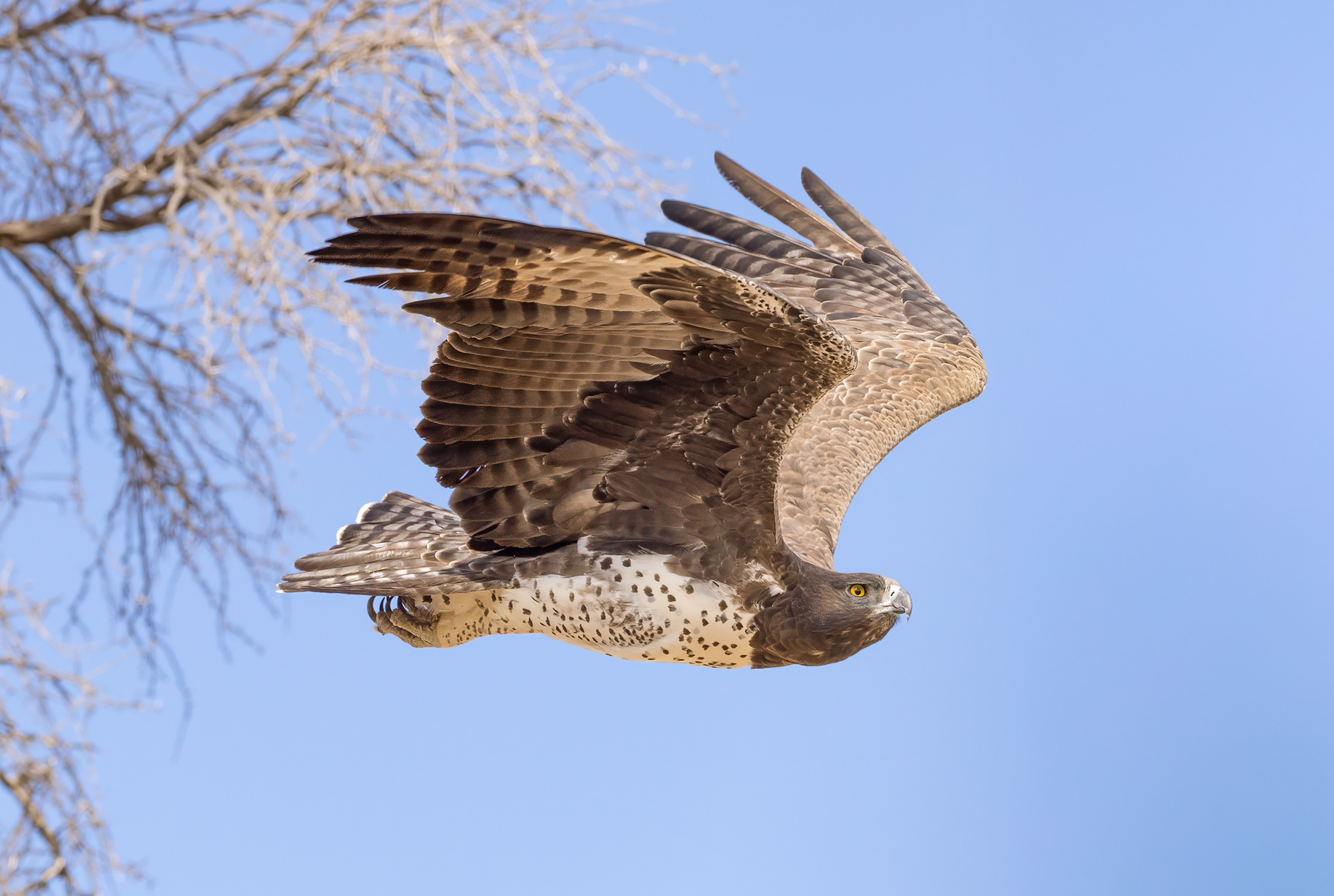
The eagle flew across the road in front of the vehicle and the above image was the last one that I was able to take before my view was obstructed by the car. It then settled into long grass on the other side of the road. I changed over to the the 400mm lens combo, waiting for it to emerge once again. We could see the grass moving but were unable to actually see the bird, even with binoculars. Although I was waiting for the bird to emerge, I was startled when it suddenly lifted out of the grass quite close to the car. I fired off a quick burst and managed to get a clear image of the bird, now carrying some grass in its beak before my view was again obstructed as it flew in front to the car. How I wished for an open vehicle!
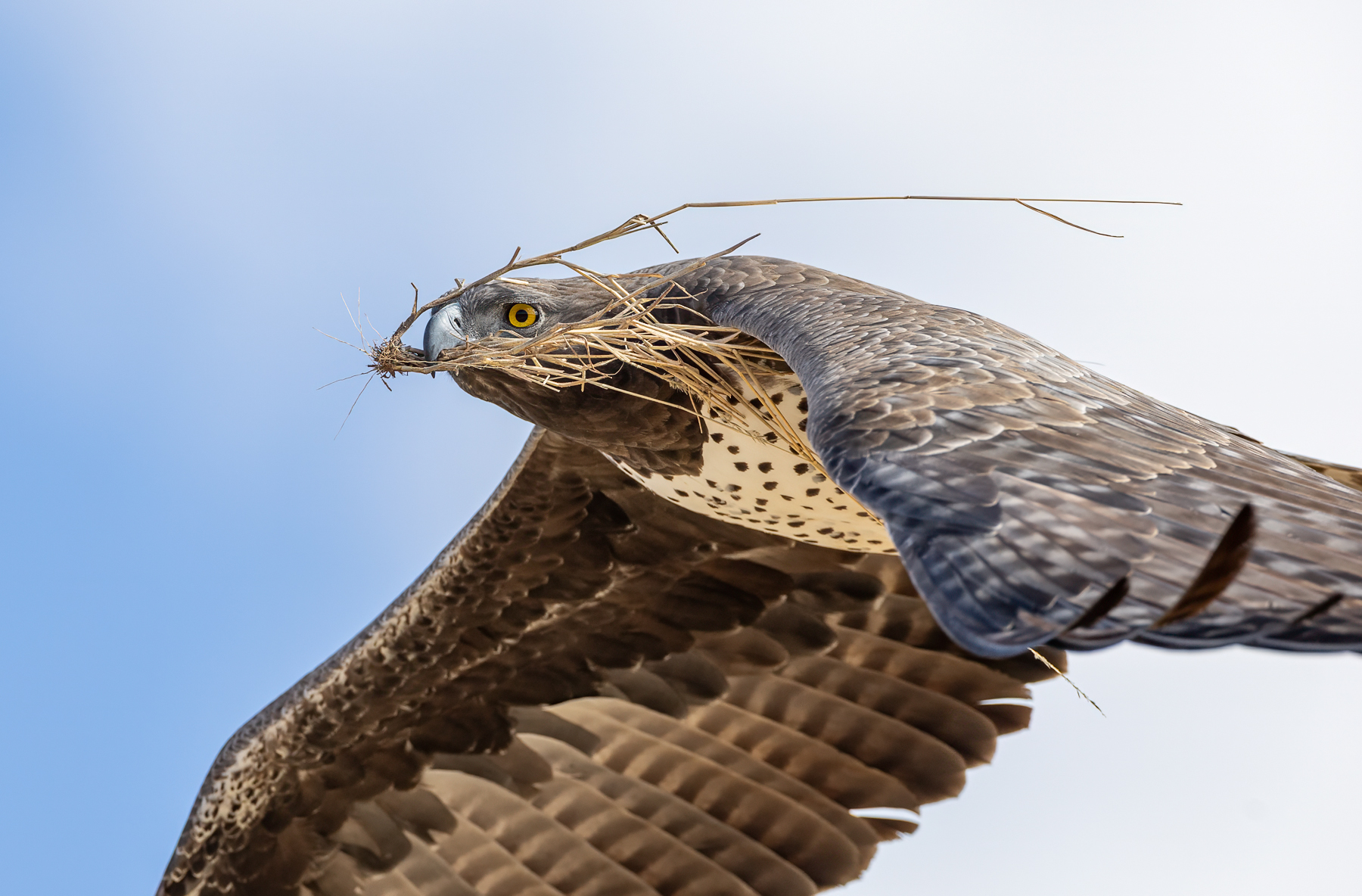
Canon EOS R3 with Canon RF 400mm f/2.8L IS USM Lens and Canon RF 1.4x extender. Handheld.
ISO 800. 1/2500 sec @ f/5.6. Exposure set manually.
The Eagle then carefully placed the tuft of grass into the nest and went back to its original place where we had seen it each time in the previous days. Not once did we see it sit in the nest or see another eagle nearby. So finally we did enjoy some action and our perseverence paid off. It was a good ending on our last full day in the park.
I will be doing another blog covering an evaluation of the equipment used for all the images in the four parts of this blog (cameras and lenses).